The World Cup Will Erase Some of the Most Valuable Stadium Names on Earth
And That’s Exactly the Point.
For decades, modern stadiums have been built as monuments to corporate power.
Brands no longer simply advertise inside sports. They become part of the architecture itself. Their names live on highways, train stations, television broadcasts, Google Maps and global conversations. Entire cities begin identifying venues by the corporations attached to them.
But every four years, something remarkable happens.
The FIFA World Cup arrives and many of those billion-dollar identities temporarily disappear.
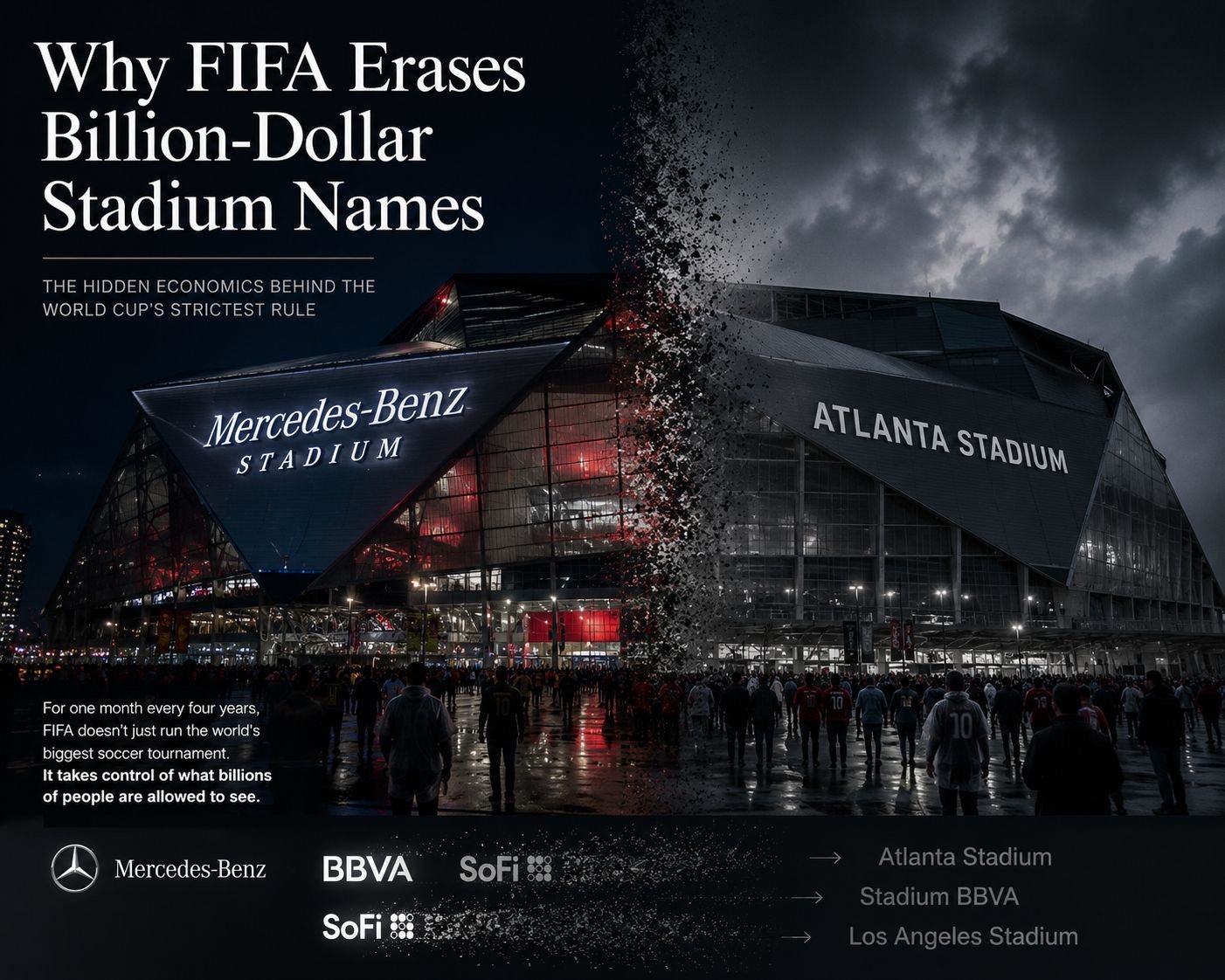
Mercedes-Benz Stadium becomes simply “Atlanta Stadium.”
SoFi Stadium transforms into “Los Angeles Stadium.”
Estadio BBVA loses its commercial identity altogether.
To most fans, the change feels cosmetic. Almost insignificant.
In reality, it reveals one of the most sophisticated and financially protected marketing systems in global sports.
Because during the World Cup, FIFA does not merely organize matches.
It takes complete control of commercial reality.
And the price of protecting that exclusivity reaches staggering levels.
The Hidden Cost of Global Exclusivity
To understand why FIFA removes stadium naming rights during the World Cup, you first have to understand what its global sponsors are actually buying.
Companies like Coca-Cola, Adidas, Hyundai and Visa are not paying simply for advertising space. They are paying for protected dominance inside the most watched sporting event on the planet.
Industry estimates place FIFA’s top-tier sponsorship agreements between $100 million and $200 million dollars per World Cup cycle. Those numbers are not tied only to logos on LED boards or hospitality suites. They are tied to exclusivity.
If a non-FIFA commercial brand were allowed to remain permanently visible through a stadium name during broadcasts, press conferences, aerial shots and global media coverage, the value of those sponsorship agreements would immediately weaken.
Imagine paying nine figures for global exclusivity while millions of viewers continue seeing another corporation’s name attached to the venue itself.
The legal implications alone could become catastrophic.
The Exposure Economy Nobody Sees
What makes the situation even more fascinating is that stadium naming rights during the World Cup are not removed because FIFA dislikes corporate branding.
They are removed because the exposure itself has measurable financial value.
Sports marketing analysts regularly calculate what is known as “equivalent media exposure” the estimated advertising value generated by unpaid television visibility, digital impressions, photographs, commentary mentions and social media circulation.
For a standard World Cup match, the commercial exposure attached to a stadium name can generate an estimated advertising equivalent between $5 million and $9 million dollars per game.
For the World Cup Final, the numbers become almost surreal.
A venue hosting the final such as MetLife Stadium, temporarily renamed “New York New Jersey Stadium” for 2026 could generate media exposure equivalent to more than $80 million dollars in a single night.
Not through commercials.
Simply through visibility.
One camera pan.
One aerial shot.
One commentator repeating a venue name across hundreds of countries.
That is how powerful the modern attention economy has become.
The Billion-Dollar Illusion of “Clean” Stadiums
What viewers see during the World Cup feels effortless.
In reality, it requires an enormous logistical operation known internally as “debranding.”
Weeks before kickoff, stadiums undergo a complete visual transformation.
Local sponsor logos are covered.
Digital signage is replaced.
Corporate graphics disappear from walls, seats, entrances and rooftops.
Even staff uniforms and operational branding are adjusted to comply with FIFA regulations.
The process costs millions.
Some venues spend over $1 million dollars purely on temporary visual conversion before a single ball is kicked.
And yet perhaps the most fascinating detail heading into 2026 involves the lone exception FIFA reluctantly allowed.
The Mercedes-Benz Exception
After nearly 18 months of negotiations, FIFA granted a highly unusual approval for the Mercedes-Benz Stadium in Atlanta to retain the iconic Mercedes star integrated into the roof structure.
Not because of sponsorship flexibility.
Because removing or covering it risked damaging the retractable roof system itself.
Even then, FIFA still removed the commercial name.
During the tournament, the venue will officially operate as “Atlanta Stadium.”
That distinction matters enormously.
Because FIFA’s objective is not simply visual consistency.
It is commercial control.
The World Cup Is No Longer Just a Sporting Event
What makes this entire system so fascinating is that it exposes how modern mega-events operate far beyond sports.
The World Cup today functions as a temporary economic ecosystem.
For one month, FIFA essentially rebuilds the branding architecture of entire cities. Stadiums, transportation systems, hospitality zones, broadcast environments and sponsor ecosystems all become part of a meticulously controlled commercial universe.
Every visible inch has value.
Every logo has legal implications.
Every camera angle is monetized.
And perhaps that is the most revealing part of all.
The real power of the World Cup is no longer only the game itself.
It is the ability to control what billions of people see while they watch it.